
THE GEMHOOD EDITORIAL LIBRARY
Prehnite gemstone guide
Prehnite is an often translucent mineral with a soft green glow, commonly fashioned into cabochons and carved beads. Quality depends on pleasing colour and polish rather than a standard grading scale; inclusions and cleavage affect toughness.
Gem facts · Quality considerations · Care & meaning
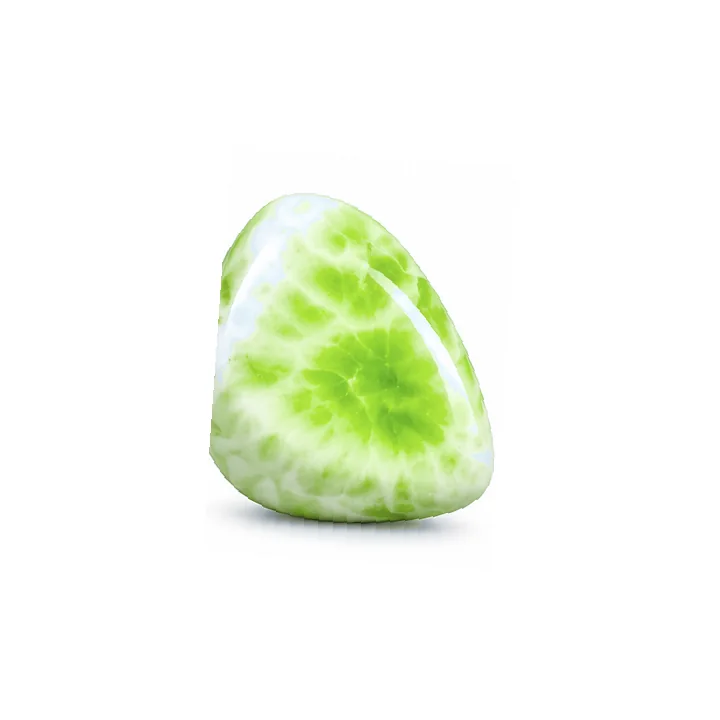 A study in colour and character
Every shade has a story.
Typical appearances for Prehnite. Natural stones vary, and lighting or treatment can change their appearance.
Where Prehnite is found
Australia; South Africa
 Australia
 South Africa
These are representative geological or commercial sources, not certified provenance for an individual stone. Country of origin should be substantiated independently when relevant to value.
01 / THE GEM AT A GLANCE
What is Prehnite?
Prehnite is a naturally occurring calcium–aluminium phyllosilicate represented by Ca₂Al₂Si₃O₁₀(OH)₂, with a reported Mohs hardness of 6–6.5. It commonly appears as Pale mint-green botryoidal, rounded translucent masses with radiating crystalline structure, sometimes tabular blades. Its documented colours include Pale green, yellow-green, colourless, white, grey. Grows in low-temperature hydrothermal veins, basalt cavities and metamorphic or altered mafic rocks.
Prehnite is an often translucent mineral with a soft green glow, commonly fashioned into cabochons and carved beads. Typical material appears in pale yellow-green to apple green shades, and is commonly described as calcium-aluminium phyllosilicate. The Mohs hardness for this material is approximately 6–6.5; hardness refers to resistance to scratching, not to breaking, cleavage or sensitivity to chemicals. Quality depends on pleasing colour and polish rather than a standard grading scale; inclusions and cleavage affect toughness. Typical geological or commercial source regions include Australia; South Africa; this does not establish the provenance of an individual gem. Use warm soapy water gently; avoid heat, hard impacts and ultrasonics. Ask for confirmation of identity, natural or lab-created status, and any treatments when choosing an individual stone.
02 / LOOK CLOSER
Colour, appearance and quality
Typical specimen appearance: Pale mint-green botryoidal, rounded translucent masses with radiating crystalline structure, sometimes tabular blades. Reported reference localities include South Africa; Australia; China; United States. These are general occurrence areas, not proof of origin for any photographed or offered specimen.
Before you choose a stone
Compare images taken in more than one lighting condition, ask for views of the actual item and check how the cut and setting change its appearance. A gemstone type is not a standard grade: each natural specimen has its own colour, inclusions and workmanship.
THE GEMHOOD BUYER'S FIELD NOTES
How to choose Prehnite: three checks
- 01
Rounded translucent prehnite aggregates can be confused with chalcedony, serpentine or green glass; hardness, crystal texture and refractive properties help clarify identification.
- 02
Check condition, actual photos, species and locality documentation, measurements and any treatment. A green translucent polished stone cannot be authenticated as prehnite from colour alone.
Ordinary mineral dust precautions apply when cutting or polishing. Avoid placing rough stones in consumables.
Prehnite can make attractive beads and cabochons, but inclusions and fracture sensitivity favour protected jewellery settings.
These notes describe typical gem material and trade practices. They do not independently grade or identify a specific item offered for sale.
03 / BUY WITH CONFIDENCE
Natural, laboratory-grown, treated or imitation?
Rounded translucent prehnite aggregates can be confused with chalcedony, serpentine or green glass; hardness, crystal texture and refractive properties help clarify identification. A green translucent polished stone cannot be authenticated as prehnite from colour alone. Require photographs of the exact object, scale, an accurate species label, evidence of any claimed locality, and disclosure of treatment, repairs and synthetic or coated substitutes.
These distinctions should be clear in the listing for any particular gem. Treatments are not automatically unacceptable, but an undisclosed treatment, vague mineral identity or unsupported origin claim prevents an informed purchase. Where material identity materially affects value, an independent gemological identification report may be worth considering.
A CLOSER LOOK
Composition, hardness and crystal science
Prehnite is a naturally occurring calcium–aluminium phyllosilicate represented by Ca₂Al₂Si₃O₁₀(OH)₂, with a reported Mohs hardness of 6–6.5. It commonly appears as Pale mint-green botryoidal, rounded translucent masses with radiating crystalline structure, sometimes tabular blades. Its documented colours include Pale green, yellow-green, colourless, white, grey. Grows in low-temperature hydrothermal veins, basalt cavities and metamorphic or altered mafic rocks.
The formula Ca₂Al₂Si₃O₁₀(OH)₂ is representative, and impurities or compositional substitution may vary with the geological occurrence. A Mohs rating of 6–6.5 measures scratch resistance only; inspect cleavage, crystal terminations and mechanical fragility separately.
A CLOSER LOOK
Appearance, colour and typical crystal habit
Prehnite is described by Pale mint-green botryoidal, rounded translucent masses with radiating crystalline structure, sometimes tabular blades. Reported colours include Pale green, yellow-green, colourless, white, grey.
Rounded translucent prehnite aggregates can be confused with chalcedony, serpentine or green glass; hardness, crystal texture and refractive properties help clarify identification. A green translucent polished stone cannot be authenticated as prehnite from colour alone. Require photographs of the exact object, scale, an accurate species label, evidence of any claimed locality, and disclosure of treatment, repairs and synthetic or coated substitutes.
A CLOSER LOOK
Geological formation and host-rock setting
Grows in low-temperature hydrothermal veins, basalt cavities and metamorphic or altered mafic rocks
Reference occurrence areas: South Africa; Australia; China; United States. Reported reference localities, not independently verified provenance for a listed product. A location on a generic educational page is not the same as a documented specimen chain of custody.
A CLOSER LOOK
History, nomenclature and frequently mistaken species
Named in honour of Hendrik van Prehn; one of the early minerals to be named after an individual.
A green translucent polished stone cannot be authenticated as prehnite from colour alone.
Compare visually similar materials such as chrysoprase; serpentine; green glass. A visual match is only a starting point, not mineralogical authentication.
A CLOSER LOOK
Identification and trustworthy mineral buying
Rounded translucent prehnite aggregates can be confused with chalcedony, serpentine or green glass; hardness, crystal texture and refractive properties help clarify identification. A green translucent polished stone cannot be authenticated as prehnite from colour alone. Require photographs of the exact object, scale, an accurate species label, evidence of any claimed locality, and disclosure of treatment, repairs and synthetic or coated substitutes.
Ask for actual measured dimensions and multiple current photos; confirm any restoration, colouring, backing, polished surface or matrix attachment. For expensive material, request a trusted independent opinion rather than relying on promotional images.
A CLOSER LOOK
Collection display and suitability for jewellery
Prehnite can make attractive beads and cabochons, but inclusions and fracture sensitivity favour protected jewellery settings. The GemHood picture is a generated educational illustration; it is not an authenticated specimen, laboratory result or sale item.
Transport specimens in individual padded boxes; support loose blades, fans or plates from beneath their host matrix, and never rely solely on the Mohs rating to decide how the specimen should be worn.
A CLOSER LOOK
Cleaning, stability and collector safety
Ordinary mineral dust precautions apply when cutting or polishing. Avoid placing rough stones in consumables. Wipe with a slightly damp soft cloth, dry promptly and avoid heat shocks, prolonged immersion, acids, harsh chemicals and ultrasonic cleaning of fractured stones.
Use the least aggressive cleaning method that preserves the species and any associated matrix. Avoid ultrasonic and steam cleaning for fragile, altered, repaired or unknown specimens; wash hands after handling mineral dust or metal-bearing samples.
A CLOSER LOOK
Understanding the GemHood mineral illustration
The illustration is intended to suggest Semi-translucent yellow-green softly rounded bubble-like aggregates with fine crystalline texture, resting on dark basalt.
This is an original educational depiction, not an authenticated specimen photograph, lab finding or purchasable product. Natural examples differ substantially in shape and colour; do not use the illustration to establish species, treatment or provenance.
04 / WEAR IT WELL
Prehnite in jewellery
Prehnite can make attractive beads and cabochons, but inclusions and fracture sensitivity favour protected jewellery settings. The GemHood picture is a generated educational illustration; it is not an authenticated specimen, laboratory result or sale item.
05 / MAKE IT LAST
How to care for Prehnite
Ordinary mineral dust precautions apply when cutting or polishing. Avoid placing rough stones in consumables. Wipe with a slightly damp soft cloth, dry promptly and avoid heat shocks, prolonged immersion, acids, harsh chemicals and ultrasonic cleaning of fractured stones.
One essential care distinction
Mohs hardness describes resistance to scratching, not resistance to breaking. Gemstones with cleavage, existing fractures, porous surfaces or fillings can need extra care regardless of their hardness number. If you do not know whether a piece has been treated, begin with the gentlest appropriate cleaning method.
06 / CULTURE & MEANING
History, heritage and symbolism
Named in honour of Hendrik van Prehn; one of the early minerals to be named after an individual.
Prehnite is included in this educational directory for its distinctive material, appearance and cultural or collector interest. Prehnite is an often translucent mineral with a soft green glow, commonly fashioned into cabochons and carved beads. Gem varieties and trade names can overlap: the precise identity of a particular specimen should be independently confirmed when relevant.
Traditional meanings and spiritual associations are part of cultural storytelling. They are not evidence that a gemstone diagnoses, prevents or treats any medical condition.
GOOD QUESTIONS, CLEAR ANSWERS
Prehnite FAQs
What is Prehnite?
Prehnite is a calcium–aluminium phyllosilicate, commonly represented by Ca₂Al₂Si₃O₁₀(OH)₂. Typical appearance includes Pale mint-green botryoidal, rounded translucent masses with radiating crystalline structure, sometimes tabular blades.
How hard is Prehnite?
A typical reported Mohs hardness is 6–6.5. Scratching resistance does not measure toughness, cleavage, safety or suitability for everyday wear.
What colour is natural Prehnite?
Reported colours include Pale green, yellow-green, colourless, white, grey. Lighting, matrix, mineral impurities and display settings can affect perceived colour.
Where does Prehnite form?
Grows in low-temperature hydrothermal veins, basalt cavities and metamorphic or altered mafic rocks Published occurrence areas include South Africa; Australia; China; United States, but these do not establish a sale item’s actual origin.
How can I identify Prehnite?
Rounded translucent prehnite aggregates can be confused with chalcedony, serpentine or green glass; hardness, crystal texture and refractive properties help clarify identification. A mineral specialist may need to examine the particular specimen.
Can Prehnite be used for jewellery?
Prehnite can make attractive beads and cabochons, but inclusions and fracture sensitivity favour protected jewellery settings.
How should I clean Prehnite?
Wipe with a slightly damp soft cloth, dry promptly and avoid heat shocks, prolonged immersion, acids, harsh chemicals and ultrasonic cleaning of fractured stones.
Is Prehnite safe to handle?
Ordinary mineral dust precautions apply when cutting or polishing. Avoid placing rough stones in consumables.
Is the GemHood Prehnite picture a real specimen?
No. It is an original generated educational illustration designed around typical Prehnite appearances. It is not a certified specimen photo, laboratory determination or a product for sale.
Which minerals can be confused with Prehnite?
Possible lookalikes include chrysoprase; serpentine; green glass. A green translucent polished stone cannot be authenticated as prehnite from colour alone.
A NOTE FROM THE GEMHOOD EDITORIAL DESK
How to use this guide
We explain gemstone properties, known mining regions and customary treatments to help you shop more confidently. Each gemstone can vary in quality and individual provenance, so compare the actual jewellery listing and request supporting documentation if origin, treatment or natural-versus-laboratory-grown status affects your choice.
Our gemstone library is educational and does not act as a laboratory identification certificate. Independent gemological assessment is advisable for valuable or disputed claims.
EDITORIAL REFERENCES
Research and further reading
References describe mineral species and representative occurrences, not verification of any individual item for sale.
No matching jewellery is currently in stock. Explore the guide or browse our full collection.
Browse jewellery →UNDERSTAND THE DIFFERENCE
Compare Prehnite with similar gemstones
These stones can overlap in colour, appearance or jewellery use. The mineral identity, treatments and durability may be very different.
KEEP EXPLORING
Other gemstones to discover
Educational articles describe gemstone types and common trade practices. They are not individual gemological certificates, current price appraisals or medical advice.